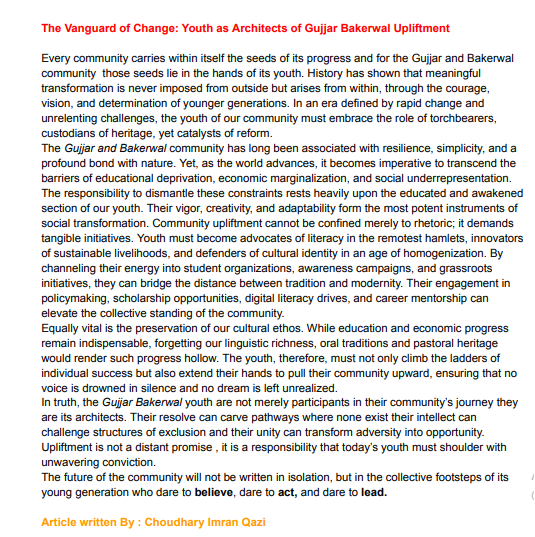
Madar-e-Meharban Begum Akbar Jahan Abdullah — A Tribute to Her Legacy
~Amir Choudhary
Some people may pass from our sight with time, but their service and character can never be forgotten. One such remarkable personality was Begum Akbar Jahan Abdullah, affectionately remembered across Jammu and Kashmir as “Madar-e-Meharban” (The Compassionate Mother).
Today marks 26 years since her passing, yet her vision, compassion, and lifelong service to the people continue to live on in countless hearts.
I am not affiliated with any political party, but an impartial reading of history shows that Begum Akbar Jahan Abdullah rendered outstanding service to the underprivileged, especially to the Gujjar and Bakarwal communities. Forgetting her contributions would be an injustice.
Following the tragic events of 1947 in Jammu, when thousands of Muslims suffered immense violence and many women were abducted, Begum Akbar Jahan played an extraordinary humanitarian role. She worked tirelessly for the rehabilitation of affected women, safeguarded their dignity, helped them rebuild their lives, arranged marriages according to their wishes, and made every effort to ensure they received their rightful protection and support. Her humanitarian work remains an enduring chapter in history.
History often presents differing opinions about public figures, but Begum Akbar Jahan consistently stood for justice, principles, and truth. It is also widely known that when the Muslim Conference was transformed into the National Conference, she expressed her disagreement based on her principles. This steadfast commitment to her convictions remains one of the defining qualities of her personality.
Among the leaders who worked for women’s rights, education, empowerment, and social welfare after Independence, Begum Akbar Jahan holds a place of distinction.
Her contributions to the Gujjar and Bakarwal community are especially significant. Although she had personal ties to the community, her efforts went far beyond that relationship. Under her guidance, several meaningful initiatives were undertaken that became historic milestones.
From supporting the establishment of the Gujjar and Bakarwal Advisory Board to promoting hostels for Gujjar and Bakarwal students, her efforts opened new opportunities for education at a time when the community had not yet been granted Scheduled Tribe (ST) status. These initiatives reflected remarkable foresight and commitment.
She gave particular attention to the education of Gujjar and Bakarwal girls, playing an important role in ensuring access to scholarships so that more young women could pursue education and build dignified, independent lives.
She also strongly raised the demand in Parliament for granting Scheduled Tribe (ST) reservation to the Gujjar and Bakarwal community, demonstrating her sincere commitment to securing their rights and future.
Our elders have always spoken of Begum Akbar Jahan Abdullah with respect, affection, and gratitude. Staying close to the people, listening to their concerns, understanding their hardships, and working sincerely to address them was the hallmark of her public life and service.
Today, 26 years after her passing, we not only pay tribute to her memory but also honour her remarkable contributions to society. Great individuals may leave this world physically, but their character, compassion, and service continue to inspire generations.
May Almighty Allah forgive Begum Akbar Jahan Abdullah, elevate her ranks, grant her the highest place in Jannat-ul-Firdous, and bless us all with the strength to serve humanity and uphold justice and truth. Ameen.
Echoes,Prayers and the Waiting Heart
~Zaffer Iqbal
It began on a dark, storm-ridden night. Lightning kept flashing against a window as if the sky itself wanted to speak. There was a time when nights like these meant quiet wonder, when a pair of eyes loved to search the sky for stars and whisper secret wishes. But on that night the curtains were drawn tight, sleep was forced, and the sound of heavy rain lulled everything into a fragile silence.
An alarm broke that silence at 3:30 a.m. A pillow muffled it for a few more minutes, but another call to wake came again. Ablution. Quiet prayer in the darkness. Four units of worship offered with a trembling heart; an inner conversation about fears, mistakes, forgiveness, and a desperate plea for the well-being of every soul. Yet the images of that storm kept flashing in the mind.
It wasn’t the first time, the world felt unfair. Words had been swallowed for years. Each attempt to speak brought louder accusations, until the voice inside learned to shut down. Loneliness became a companion. The hunger was no longer for food but for respect, affection and someone to simply listen. The safest place was a closed room where walls could not scream back.
Days blurred. Even going to class felt like climbing a mountain, the only motivator was attendance. Meals were small, simple and eaten alone. Inside the narrow walls, where the ceiling seemed to press downward, echoes grew louder. Questions hung in the air long after they were spoken. Anxiety and depression crept in quietly, like dampness in a corner.
But one day felt different. A realization arrived the way a precious stone is discovered after years of mining. Life’s purpose, the reason for being created, flickered into focus. Guidance appeared—not through a person’s voice but through an inner nudge from the Creator: wait, stay silent until the right time. Hard to accept, but obedience to the right path promised a beautiful destination. That night the walls still closed in, but a prayer rose higher than the ceiling: “Give us strength, give us faith, make us patient until we’re united at the right moment.” It felt like losing something, but it was actually an invitation to grow.
Later came a small triumph. An exam once believed impossible was passed. The news spread to family, tears came before words. Gratitude was offered in private prayer. Even then, the happiness was difficult to express to the one who had silently guided and encouraged. It felt like standing on a step of a staircase that led toward a better version of the self.
Over time prayer itself changed. What used to be rushed became slow, deliberate, soaked in tears and gratitude. Reels about faith could bring sobs. The self who once prayed only for others now began to include itself in the whispers to heaven. Jealousy and longing still flickered—watching others speak freely while remaining on the outside—but the heart learned to smile at others’ happiness even when it hurt.
Some words cut deep, yet even these wounds were turned into fuel. They became reminders of boundaries, of dignity, of the need to protect hearts from slipping into haram. Weakness would visit for an hour or two, but faith returned stronger. The belief grew stronger, one step toward the creator brings ten steps in return. Late nights no longer meant wasted hours but preparation for dawn prayers. Dua after dua filled the hours until sleep. Studies became both an escape and a promise for the future.
This story is not about losing, it is about transforming. It is about a soul that started as a storm-struck observer at a window and maybe becoming a diamond forged in pressure, prayer and patience. It is about learning to stay silent until the right time, to walk toward light even when walls close in, and to keep faith that at the appointed hour, everything and everyone meant to be together will meet on the path laid out by the One who knows best.
Education as Liberation: Empowering India’s Nomadic Tribes through Constitutional Justice
~Zakir Hussain
Executive Summary
India’s nomadic and semi-nomadic tribes, such as the Gujjar–Bakarwals, remain among the most educationally deprived communities despite constitutional guarantees and policy commitments. This article examines the historical marginalization of these groups, evaluates existing interventions like the Right to Education Act (2009), Eklavya Model Residential Schools, and NEP 2020, and draws lessons from global practices in Kenya, Mongolia, and the Middle East. It argues for a rights-based, inclusive framework that combines mobility-sensitive education, digital innovation, and community participation. Education for nomads is not charity but constitutional justice under Articles 21A and 46 — and a step toward fulfilling India’s democratic promise.
Introduction
“Education is the most powerful weapon which you can use to change the world.” Nelson Mandela
For India’s 10 crore nomadic and denotified tribes, this “weapon” remains out of reach. Communities like the Gujjar–Bakarwals of Jammu & Kashmir, the Lambadas of Telangana, and the Dhangars of Maharashtra continue to face systemic exclusion from formal education. Seasonal migration, lack of settled schools, and deep social prejudice mean that literacy rates among nomadic groups often remain 20–30% lower than the national average (Census of India, 2011).
At stake is not just individual empowerment but social justice, constitutional morality, and inclusive nation-building.
Constitutional and Legal Anchoring
The Indian Constitution provides a strong normative basis:
Article 21A – Right to free and compulsory education for children (6–14 years).
Article 46 – Directive to promote the educational and economic interests of SCs, STs, and weaker sections.
Article 39(f) – Obligation to protect childhood and youth.
Unni Krishnan v. State of Andhra Pradesh, (1993) 1 SCC 645 – Supreme Court recognized education as part of the right to life even before Article 21A was added.
Together, these provisions establish that education for nomadic children is a constitutional obligation, not a matter of welfare.
The Persistent Gaps
1. Mobility and Access
Fixed-school models fail nomadic groups who migrate seasonally with livestock.
Example: Gujjar–Bakarwals face a six-month migration cycle from Jammu plains to Kashmir’s highlands (Sharma & Bhat, 2020).
2. Infrastructure Deficits
CAG Reports (2019, 2021) show delays in construction of Eklavya Model Residential Schools (EMRS), with many sanctioned schools still non-operational.
3. Social Exclusion and Stigma
Denotified Tribes (DNTs) still face labeling as “criminal tribes” — a colonial legacy that discourages integration into mainstream institutions (Radhakrishna, 2001).
4. Policy Fragmentation
Overlaps between the Ministry of Education, Ministry of Tribal Affairs, and state departments often result in underutilization of funds (NITI Aayog, 2018).
Policy Interventions and Their Limits
1. Right to Education Act (2009) – Expanded access, but fails to account for mobility.
2. Eklavya Model Residential Schools (1997) – Positive step, but limited coverage and delays (Ministry of Tribal Affairs, 2022).
3. National Education Policy (2020) – Recognizes need for “special education zones,” but implementation lags.
4. Hostel and Scholarship Schemes – Useful, but often inaccessible due to lack of awareness and documentation.
Evaluation: India has made progress, but interventions remain static, fragmented, and poorly adapted to nomadic life.
Global Lessons
• Kenya: Mobile schools (tented classrooms that move with pastoralists) under the Nomadic Education Policy (2010) (Republic of Kenya, Ministry of Education).
• Mongolia: Ger schools (portable tent schools) with solar-powered digital learning kits (UNESCO, 2015).
• Middle East (Bedouins): Boarding schools combined with vocational training for pastoral livelihoods (UNICEF, 2018).
• Lesson for India: Adopt a National Nomadic Education Mission, institutionalizing mobility-sensitive, tech-enabled schooling.
Success Stories in India
• Seasonal Hostels (Karnataka, Odisha) – Allow children to stay back and study while parents migrate (Jha & Jhingran, 2019).
• Digital Classrooms (Rajasthan) – Tablets and recorded lectures bridging gaps.
• Community Instructors (J&K) – Gujjar–Bakarwal elders trained as para-teachers (Singh, 2021).
These experiments show that flexible, culturally rooted solutions work better than one-size-fits-all models.
Way Forward: A Rights-Based Framework
1. Mobile and Seasonal Schools – Expand tent schools, boat schools, and digital classrooms.
2. Community Participation – Train nomadic youth as para-teachers; integrate local languages.
3. Institutional Reform – Establish a National Commission for Nomadic Education to coordinate efforts.
4. Digital Innovation – Offline e-learning modules, solar-powered devices, and AI-driven curriculum tracking.
5. Legal Recognition – Extend explicit protections under RTE Rules to nomadic children.
6. Monitoring and Accountability – CAG-style audits of EMRS and tribal education funds.
Conclusion
As Dr. B.R. Ambedkar warned, “Political democracy cannot last unless there lies at the base of it social democracy.” Education for nomadic communities is central to this social democracy.
For government policymakers, it is a chance to bridge historical injustice with future opportunity. For civil society, it is a moral call to end centuries of exclusion. For academia, it is a test of how constitutional promises translate into lived realities.
Education for nomads is not a gift — it is a right, a justice, and a necessity.
Policy Recommendations (At a Glance)
1. Launch a National Nomadic Education Mission.
2. Institutionalize mobile/seasonal schools across states.
3. Strengthen digital inclusion with solar-powered offline learning kits.
4. Ensure community-led teaching models.
5. Create strong monitoring mechanisms for tribal education funds.
References
1. Census of India. (2011). Primary Census Abstract. Registrar General of India.
2. Comptroller and Auditor General (CAG). (2019, 2021). Performance Audit Reports on EMRS. Government of India.
3. Jha, J., & Jhingran, D. (2019). Elementary Education for the Poorest and Other Deprived Groups. Manohar Publishers.
4. Ministry of Tribal Affairs. (2022). Annual Report. Government of India.
5. NITI Aayog. (2018). Strategy for New India @75. Government of India.
6. Radhakrishna, M. (2001). Dishonoured by History: ‘Criminal Tribes’ and British Colonial Policy. Orient Blackswan.
7. Republic of Kenya, Ministry of Education. (2010). Nomadic Education Policy for Kenya.
8. Sharma, R., & Bhat, A. (2020). “Educational Challenges of Gujjar-Bakarwals in J&K.” Economic and Political Weekly, 55(22).
9. Singh, P. (2021). “Community-Led Schooling Models in J&K.” Indian Journal of Social Development, 21(2).
10. UNESCO. (2015). Mobile Learning for Pastoralist Children in Mongolia. UNESCO Publishing.
11. UNICEF. (2018). Education for Bedouin Children in the Middle East. UNICEF Regional Report.
12. Unni Krishnan v. State of Andhra Pradesh, (1993) 1 SCC 645.
Gojri Kahani by Altaf Naqashbandi
آخیر چیت مانھ گرمی تے دھوپ تپی وی تھی تے جنگل مانھ بکریاں ناھ کھان واسطہ کجھ نہیں تھو چاچا مکھنا گو ڈھیرو وی چنگا اُچا نکا ور تھو تے دو ترے مہینا روڑا نھ ہو گیا تھا تے پانی گی وی شدید کِلت تھی چاچا مکھنا کا دو جوان نکا تھا وے اپنا باپ نال کم مانھ پورو ساتھ دیں تھا لیکن دور دراز علاقاں مانھ رہین گی وجہ تیں چاچو مکھنو ان دوا ناھ پڑا نی سکیو
خیر اسے طرح مزید گرمی تے دھوپاں مانھ آضافو ہون لگو تے چاچا مکھنا نے سوچیو جے کسے گو رلو وی نہیں تیراں تے ہن ہوں تے دوے جاتک آہستہ آہستہ لے چلاں ٹہوکاں آلا پاسا آخر ترے ہی باپ پوت چل پیا تے تھوڑا ہی دور گیا تھا جے سکیروٹی راکھا نے روک لیا تے پرمٹ گو پچھیو خیر نکا دوے ڈر گیا لیکن چاچا مکنھا نے منت آزی کر کر آخر وے نی منیا تے اُنہاں ناھ آجازت نی لبھی تے چاچا مکھناں نے آپنو سارو مال پاروں ڈھکنو پے گیو اِت کوے اتنو زیادہ مال پاروں گا کھان واسطہ وی کجھ نہیں تے آسے پاسے لوکاں گو فصل وی تھو تے تریاں نے سلاہ مشورہ کیو تے چاچا مکھنا ناھ واپس پرمٹ در مُڑنو پے گیو تے ان دواں آپنا لڑکا ناھ مال نال چھوڑنو پے گیو آگر کیتا نستا پجتاں کوے مال بکری کسے گا فصل مانھ پے جے تےچاچو مکنھو تھوڑی پکیری عمر مانھ تھو اس ناھ لوگ اتنا کجھ نی تھا کہیں خیر ان چاچو مکھنو واپس آہ گیو تھو پرمٹ بنان واسطہ تے لڑکا دوے اکیلا ہی مال نال تھا ۔مال ناھ وے اُت گا بسنیک لوگ اتنا پھیرن نی دے تھا تے ناھ ہی مال اُت دواں پہیاں ناھ رات سون دے تھو رات گی نید وی حرام ہو گی تے مال گو وی خستہ حالت ہو گی
اسے طرح بہت مشکل مانھ لاچار بے بس ہو گیا اگے سکیورٹی راکھا نی جان دیتا تے اور نہ ہی لوگ ان ناھ ات فصلاں گے کنڈا رہین دیں چاچو مکھنو رات گھر پجیو تے دھوجا دن تحصيل آلے پاسے ٹر گیو تے ٹھیک وقت پر پہجھ گیو لیکن تحصیل مانھ اجاں کوے نہیں آیو تھو خیر چاچا مکھنا نا ایک ایک منٹ وی گھنٹو لگے کیوں جے آپنا مال اور دواں جاتکاں گو فکر مچ ہی تھو آخر تحصیل مانھ کجھ ملازم پجیا تے چاچا مکنھا نے آپنی فایل بنان واسطہ عرضی نفیش ناھ کیو تے فایل تیار کروائی لیکن چاچا مکنھو آپنا راشن کارڈ کی کاپی گھر ہی پُل گیو تھو تے کلرک نے فایل نی لی کہن لگو جے چاچا راشن کارڈ گی کاپی لا اس گے نال اس توں بغیر نہیں ہوتو چاچا مکھنا نے اپنی پوری روداد سنائی لیکن زور آگے شور کے کرے آخر کجھ نی ہو سکیو تے چاچو مکھنو بے بس ہو گے واپس گھر آلے پاسے ٹر پیو ہور ٹھیک دیگر ناھ گھر پُجھ گیو تے رات کس ناھ نید پوے کیوں جے مال اور آپنا لڑکاں گی مڑ مڑ گے سوچتو رہیو تے صبح پھر تحصيل آلے پاسے ٹر پیو راشن کارڈ لے گے پُجھ گیو تے کلرک ناھ دسیو تے فایل درج کر چھوڑی تے چاچا مکنھا ناھ آس لگ گی کے اج میرو پرمٹ بن جے گو لیکن جیسو ہی کلرک لے گے نایب تحصیلدار گا ٹیبل پر رکھی تے چاچو مکھنو پیش کیو اور کلرک واپس آپنا کم در چلیو گیو نایب تحصیلدار نے چاچا مکھنا در دیکھیو تے کجھ نی بولیو تے آپنا فون کن نال لا گے گلاں گو نظارو لین لگ پیو آخر آدھو پہنو گھنٹو گزر گیو تے گل نی مکتی مزید دلچسپ گل لگ پہی تے چاچو مکھنو کھڑو ہو گے دیکھتو رہیو لیکن اس گی فایل بند کر گے ٹیبل ور ہی پیی رہی آخر ایک گھنٹو گزر گیو تے فون وی کٹ ہویو تے فایل کھولی تے پچھیو ہاں چوہدری کے مسلو ہے اکھے کوے نی جناب یو پرمٹ بنانو ہے اگے توں جواب ملیو جا اس گے اُپر پٹواری کولو رپورٹ کروا گے لے گے آہ فر بنا گو اوہو ہو چاچو مکنھو تھک گے فرش ور بیس گیو تے منت آزی کرن لگ پیو جے ہون پٹواری وی کافی دور ہے کد ہوں ریپورٹ کروا گے لےایو لایو اسے طرح کجھ کر گے دیو جی میرو مال پاروں راہ مانھ کھجل ہویو وی ہے لیکن صاحب گا ہتھ مانھ پاور اورطاقت ہےکِتوں بھیچارہ غریب لاچار گی کوے سنے آخر دوجہ دن پھر گھر مڑ آیو تے کہن لگو جے میرو کوے نی رات پھر سوچتاں سوچتاں کڈی تے تیسرہ دن پٹواری کول جا پہجیو تے رپورٹ کروا گے لے آیو گھر پھر چوتها دن تحصيل آلا پاسے ٹر پیو تے جا گے فایل جما کروائی تے اگے توں جواب ملیو چل چوہدری باہر بیٹھ دو بجے توں بعد لے جایاں اتھے رش ناھ پا!!
آخر دو بھجے تک بیٹھو رہیو تے پھر پیش ہویو تے پرمٹ ور دسخط کیو تے انٹری کر گے دیتو تے چاچو مکھنو گھر آلا پاسے چل پیو آج یو پنجمو دن تھو دربدری گو چھویں دن صبح ہی چاچا مکھنا نے آپنا مال آلے پاسے رُخ کر لیو تے چل پیو شام ناھ آپنا مال کول پُجھ گیو تے آپنی پوری داستان آپنا دواں لڑکا ناھ سنائی تے
لڑکا وی مایوس ہو گیا تے سوچن لگا کاش ہم وی چار کلاس پڑیا وی ہوتا چلو جس طرح اللہ گی مرضی وہ بہتر ہی کرے گو
صبح سرگی ہوتاں ہی مال ٹور لیو تے سکیورٹی راکھا ناھ پرمٹ دہس گے آگے چل پہیو اور اگے ہر جگہ بار بار گھوڑاں کی چھٹ کھول گے چیک کرتا رہیا اور چاچو مکھنو دُکھ تکلیف سہتو رہیو ۔۔۔
Saqi and Soni (A Tale Of Love And Betrayal)
~Choudhary Nadeem Baksh
Saqi was a quiet boy who loved spending time with his books. One bright morning, he sat on a wooden bench under a large chinar tree in the college courtyard. His eyes were fixed on his notes as he prepared for the upcoming exam.
Suddenly, a soft voice interrupted his concentration.
“Hi, I’ve seen you here a few times,” said a girl with sparkling eyes and a confident smile. “Would you like to study together sometime?”
Saqi looked up, surprised to see a beautiful girl standing before him.
“I… yes, that would be nice,” he replied, feeling his heart beat faster.
“My name is Soni,” she introduced herself.“I think we could help each other.”
That simple invitation started a connection neither of them expected.
After that first meeting, Saqi and Soni started seeing each other regularly. At first, it was just about studying, but soon their conversations became longer, more personal. Soni was always attentive, listening to Saqi’s hopes and fears as if they were precious secrets.
One afternoon, while they sat in the college library, Soni looked at Saqi and said softly, “You’re different from everyone else, Saqi. You’re kind and honest. I feel like I can trust you.”
Saqi smiled shyly, his heart beating faster than ever. “I feel the same, Soni. I’ve never felt this close to anyone before.”
Days turned into weeks, and their bond grew stronger. They shared dreams of a future together— quiet evenings, success in their careers, and a life built on love and trust.
One evening, beneath the stars, Saqi held Soni’s hand and promised, “I’ll always be there for you. No matter what happens, I’ll protect you and never let you down.”
Soni’s eyes shimmered with unshed tears. “And I promise to always be honest with you. You mean everything to me.”
For Saqi, those words were everything. His love for Soni became a burning flame, a belief that their love could conquer all obstacles.
Awesome! Here’s Chapter 3: The Shadow of the Past — when Soni reveals about her ex, building tension and trust with Saqi.
One afternoon, as they sat beneath the large chinar tree where they first met, Saqi noticed a shadow cross Soni’s face.
“Soni, is something bothering you? You seem distant lately,” he asked gently.
She hesitated, looking down at her hands. After a deep breath, she whispered, “There’s someone from my past… my ex-boyfriend. He’s been threatening me.”
Saqi’s heart tightened. “Why didn’t you tell me before?”
“I was scared,” she admitted. “He… he blackmails me. Keeps calling, sending messages. I don’t know what to do.”
Saqi reached out, holding her hand firmly. “You don’t have to face this alone. I’m here. I’ll protect you—no one will hurt you while I’m around.”
Soni’s eyes searched his face, looking for truth. “Do you really mean that?” “Every word,” Saqi promised, his voice steady. From that day, Saqi felt even more responsible for Soni. His love deepened into a fierce protectiveness. Every threat against her was a threat against their future.
Soni had started checking her phone more often, her eyes filled with nervousness every time a message popped up. Saqi noticed the change—the way her smile faded quicker, the way she looked over her shoulder while walking.
One evening, she met Saqi near the college canteen, her face pale.
“He’s back,” she said before Saqi could even greet her. “My ex… he’s here in the city.”
Saqi’s eyes widened. “What? Did he contact you again?”
She nodded. “He came near my house… just stood outside. Said he wants to meet. Said he’s changed.”
Saqi clenched his fists. “You’re not going, right?”
Soni hesitated. “I… I don’t know. Maybe just once—to tell him to stop.”
“No, Soni,” Saqi said firmly. “You don’t owe him anything. He’s just manipulating you again.” Soni looked away, troubled. “It’s not that easy.”
For the first time, Saqi felt helpless. Love gave him strength—but fear had started casting shadows over their bond.
She didn’t tell Saqi the full truth. “I just talked to him for five minutes,” she said casually, but in reality, she had met him alone at a café, stayed longer, and listened to everything he said.
Her ex-boyfriend, Rayyan, was cunning. He didn’t beg—he played the victim.
“I’ve changed, Soni,” he said, eyes full of crafted sadness. “You were the only real thing in my life. I was lost… but I’m back. Don’t I deserve one more chance?”
Soni didn’t reply. Her heart was confused. Part of her still remembered the pain he caused, but another part was stirred by the way he spoke—how familiar he felt.
Over the next few days, Rayyan sent her old pictures, messages, even love letters he claimed to have kept. Slowly, he painted Saqi as a “distraction,” a temporary phase.
Saqi noticed Soni pulling away—her replies became colder, her eyes distant.
One night, when he asked, “Are we okay, Soni?”
She paused… then smiled faintly. “Of course. Just a little tired.”
But in that smile, Saqi saw something dying—something he couldn’t name yet. His heart began to fear the truth long before it arrived.
That’s how long it lasted—six months of smiles, of promises, of deep love from Saqi’s side and carefully crafted illusions from Soni’s.
The winter air was cold the day she called him to the chinar tree—their place. Saqi arrived with hope in his eyes, love in his voice. He thought maybe she wanted to fix things.
Soni stood silently, wrapped in a beige shawl, eyes lowered. She didn’t smile.
“I need to tell you something,” she said softly.
Saqi stepped closer. “What is it, Soni?”
She looked up, her voice steady but distant. “Rayyan… I’ve decided to give him another chance.”
Saqi froze. “What? After everything he did to you?”
“He says he’s changed. And… maybe I never truly moved on. I thought I had. But I was wrong.”
His world crashed. “And what about me? About us?”
Soni hesitated. Then with a painful, beautiful lie, she said, “You were never more than a good friend, Saqi. I thought I loved you… but maybe it was just comfort.”
Saqi didn’t speak. His soul shattered behind his silence. Everything he had built in those six months—trust, dreams, love—crumbled in seconds.
As she walked away, Saqi stood alone, the chinar leaves falling like silent tears.
And in that stillness, he understood: Sometimes, the ones who hold your heart the closest are the ones who break it the hardest.
Days turned into weeks. Weeks into months.
Saqi was no longer the boy who smiled at butterflies or laughed at the little things. The campus where they once walked together became just walls and stones to him. His eyes still searched for her in the crowd, though he never admitted it.
He didn’t cry—not because he was strong, but because something inside him had dried up. The tears had run out. So had trust.
He still sat beneath the chinar tree sometimes—alone, silent, staring at the sky.
His friends tried to bring him back to life, but Saqi was living with a ghost… the ghost of a girl who said she loved him, then walked away.
People said, “Move on.”
But how do you move on from someone who took your soul when she left?
Saqi waited—not because he thought she would return, but because his heart never learned how to stop.
And in that long, aching wait, he changed. His eyes still had depth, but no warmth. His smile returned on rare occasions, but never reached his eyes.
Saqi didn’t hate Soni.
He just stopped believing in promises, in fairy tales, in the kind of love that hurts you and then expects you to heal.
He became a man carved by pain.
Not broken. Just... emotionless.
Bench beneath the chinar tree, the place where everything had started so beautifully. Soni arrived late, wrapped in a dark jacket, eyes downcast.
Saqi’s voice was soft but edged with hurt. “Why did you pull away? Why did you let him back in?”
Soni swallowed hard, trembling slightly. “I thought I could handle it. I thought I was strong enough to face my past.”
“But what about us?” Saqi’s voice cracked. “What about the promises we made?”
She looked up, tears threatening to spill. “I wanted to believe he had changed, Saqi. I wanted to find some part of the girl I used to be before all this pain.”
Saqi’s eyes glistened. “And what about me? Was I just a place to rest before you went back to him?”
Soni shook her head quickly. “No, never. You meant more than I can explain.”
“But it still hurts,” Saqi whispered. “Every time you look at your phone and I’m not the one who’s there.”
Soni reached out, her fingers brushing his. “I’m sorry. I never meant to hurt you. I’m just... lost.”
For a moment, the world seemed to still, their breaths mingling in the cold air.
Saqi pulled her close. “I love you, Soni. But love sometimes hurts more than it heals.”
She rested her head on his shoulder. “Maybe that’s what love is.”
The fragile thread between them stretched thinner, but neither was ready to let go.
In the shadows of their love, they would either find healing or destruction.
The days that followed were a whirlwind of conflicting emotions.
Saqi tried to hold on, but the pain in his heart was like a storm battering against a fragile boat. Every smile from Soni felt fragile, every word laced with hesitation.
One afternoon, Saqi waited for Soni outside the college gate. She arrived, eyes red-rimmed, clutching her bag tightly.
“Soni,” he called softly. “We need to talk.”
She nodded, her voice barely above a whisper. “I know.”
They walked slowly toward the chinar tree, the place that had witnessed the start of their story.
Saqi stopped and faced her. “I can’t keep living like this—wondering if the next call you get will be from him. Wondering if I’m even enough.”
Soni looked away, biting her lip. “It’s not you, Saqi. It’s me.”
He shook his head, frustration bubbling up. “Don’t say that. Don’t push me away.”
Her hands trembled. “I’m scared. Scared that I’m breaking you.”
Saqi stepped closer, his eyes searching hers. “I’m already broken, Soni. But I want to fix us. I want to fight for you.”
Tears spilled down her cheeks. “I don’t know if I can fight anymore.”
The silence that followed was deafening.
Saqi’s voice softened. “Then tell me the truth. Are you still with him? Or am I fighting a lost battle?”
She took a shaky breath. “I ended it with Rayyan. But his shadow still haunts me.”
Saqi pulled her into an embrace. “We’ll face those shadows together.”
But deep inside, doubt had already begun to creep in.
Because sometimes, love alone isn’t enough.
The air between Saqi and Soni grew heavier with each passing day, like a storm ready to break.
They tried to hold on — to the memories, to the love, to the hope — but cracks were widening, threatening to swallow them whole.
One evening, Saqi sat by the chinar tree alone, his mind racing with doubts.
When Soni arrived, her footsteps slow and hesitant, he looked up.
“Can we talk?” she asked quietly.
He nodded, heart pounding.
They sat together, silence stretching before Soni finally spoke.
“I don’t want to hurt you anymore,” she said, voice trembling.
Saqi reached for her hand. “Then don’t.”
“I’m torn, Saqi. Between the past and the future. Between who I was and who I want to be.”
Saqi’s throat tightened. “I want to be part of your future.”
She smiled sadly. “I wish it were that simple.”
Tears welled in her eyes. “Maybe we need time apart to figure out what we really want.”
Saqi’s heart shattered but he nodded. “If time is what we need, then so be it.”
They stood, a final embrace hanging between them — warm, but filled with the weight of goodbye.
As Soni walked away, Saqi whispered to the falling leaves, “I don’t want this to be the end.”
But sometimes love leads us to the edge — where we must choose to hold on or let go.
Days turned into weeks.
The absence was loud. Saqi felt it in the quiet corners of his room, in the echo of footsteps in college corridors, in every saved message he couldn’t bring himself to delete.
He still sat under the chinar tree, but now he sat alone. The laughter they once shared had vanished, replaced by a heavy silence that refused to leave.
Soni had stopped coming to college for a while. No messages. No calls.
His friends noticed the change.
“You should move on, Saqi,” one said gently.
But how do you move on when every part of your life carries the fingerprint of someone you loved?
At night, Saqi stared at the ceiling, remembering her laugh, her eyes, the way she said his name like it meant something.
He had deleted her number, but the digits still lived in his memory.
He didn’t reach out—not because he was angry, but because he didn’t want to become a burden. Maybe she needed peace. Maybe she had already moved on.
And yet, every time the wind rustled the chinar leaves, he hoped she was thinking of him.
Some bonds don’t break with distance—they just ache quietly.
Saqi wasn’t waiting for her return.
He was simply learning how to exist without the one who made his world feel full.
It had been nearly two months.
Saqi was slowly learning how to breathe again. He didn’t smile much, but he started showing up to class, answering questions, helping others like before.
But the spark in his eyes — the one Soni had once kindled — was missing.
One cloudy afternoon, as he walked out of the library, he froze.
Across the courtyard, standing near the canteen, was Soni.
She looked almost the same — same black shawl, same soft eyes — but there was something different. A tiredness. A weight.
Their eyes met.
Neither moved.
Saqi’s heart pounded against his ribs. He didn’t know whether to walk away or run to her. She, too, looked unsure. A half-step forward. Then hesitation.
He looked down, pretending to be busy with his books.
But she walked toward him.
“Hi,” she said softly, like a memory whispering.
“Hi,” he replied, guarded. For a moment, neither spoke.
“How have you been?” she asked.
Saqi gave a small smile. “Alive.”
She laughed quietly. “That’s a start.”
There was so much to say, but neither dared.
“I just... saw you and thought I should say something,” she added.
He nodded. “Thanks.”
An awkward silence followed. The kind that grows in places where love once lived.
Soni finally said, “I should go.”
“Take care,” Saqi replied, his voice gentle but distant.
As she walked away, he didn’t stop her.
Because sometimes, the heart knows what the lips can’t say — and love, no matter how deep, must learn to live with silence.
After that brief encounter, everything inside Saqi unraveled again.
He had convinced himself he was healing. That he had learned to let go. But seeing her—even for a minute—brought everything back. Every whispered promise. Every heartbeat they had once shared.
That night, he couldn’t sleep.
He kept replaying her voice in his head. “Hi... I should say something.”
Why did it still hurt? Why did he still care?
Love, he realized, wasn’t always soft and healing. Sometimes, it was a wound that reopened with a memory. A scar that burned under cold rain.
He picked up an old notebook where he used to write poems and thoughts. He flipped to a blank page and wrote: “I loved you so much, I forgot how to love myself.”
And that was the truth. In loving her, he had given away every soft part of his soul. And now, all that remained were echoes and ashes.
Saqi started avoiding the chinar tree. It hurt too much now. Everything around it reminded him of their beginning... and their end.
Meanwhile, Soni watched him from a distance, regretting her silence more than her choices. She had made her decision. But she didn’t know how to live with it.
Some nights, she scrolled through old pictures and almost called him.
Almost.
But she never did.
Because when love hurts, sometimes both hearts bleed in silence — too proud to speak, too broken to heal.
Seasons changed. The chinar tree shed its leaves and bloomed again.
But Saqi didn’t.
He had learned to live with silence, to smile just enough so people stopped asking if he was okay. He buried his feelings beneath college notes, coffee cups, and late-night walks alone.
Soni had disappeared from his world. She didn’t message, didn’t call, didn’t try again.
And neither did he.
But the wound never truly closed. It just stopped bleeding on the surface.
One afternoon, as he sat alone in the back corner of the library, he opened his notebook—the one that had become a graveyard of unsent letters.
He wrote for the last time: “You never said goodbye. And maybe that was the cruelest part— Leaving without the decency of an ending.”
Then he closed the notebook. And left it there, on the shelf between books they once read together.
Not out of anger. But acceptance.
Some people don’t walk out of your life.
They stay, forever frozen in a memory—unfinished, unanswered, and unforgettable.
Saqi walked past the chinar tree one last time. He looked up at the branches, now green again, alive.
He touched the wooden bench.
And kept walking.
Not with bitterness.
Not with hope.
But with the quiet strength of someone who loved deeply, lost silently, and lived anyway.
The End.
The Vanguard of Change: Youth as Architects of Gujjar Bakerwal Upliftment
~Choudhary Imran Qazi
Every community carries within itself the seeds of its progress and for the Gujjar and Bakerwal
community those seeds lie in the hands of its youth. History has shown that meaningful
transformation is never imposed from outside but arises from within, through the courage,
vision, and determination of younger generations. In an era defined by rapid change and
unrelenting challenges, the youth of our community must embrace the role of torchbearers,
custodians of heritage, yet catalysts of reform.
The Gujjar and Bakerwal community has long been associated with resilience, simplicity, and a
profound bond with nature. Yet, as the world advances, it becomes imperative to transcend the
barriers of educational deprivation, economic marginalization, and social underrepresentation.
The responsibility to dismantle these constraints rests heavily upon the educated and awakened
section of our youth. Their vigor, creativity, and adaptability form the most potent instruments of
social transformation. Community upliftment cannot be confined merely to rhetoric; it demands
tangible initiatives. Youth must become advocates of literacy in the remotest hamlets, innovators
of sustainable livelihoods, and defenders of cultural identity in an age of homogenization. By
channeling their energy into student organizations, awareness campaigns, and grassroots
initiatives, they can bridge the distance between tradition and modernity. Their engagement in
policymaking, scholarship opportunities, digital literacy drives, and career mentorship can
elevate the collective standing of the community.
Equally vital is the preservation of our cultural ethos. While education and economic progress
remain indispensable, forgetting our linguistic richness, oral traditions and pastoral heritage
would render such progress hollow. The youth, therefore, must not only climb the ladders of
individual success but also extend their hands to pull their community upward, ensuring that no
voice is drowned in silence and no dream is left unrealized.
In truth, the Gujjar Bakerwal youth are not merely participants in their community’s journey they
are its architects. Their resolve can carve pathways where none exist their intellect can
challenge structures of exclusion and their unity can transform adversity into opportunity.
Upliftment is not a distant promise , it is a responsibility that today’s youth must shoulder with
unwavering conviction.
The future of the community will not be written in isolation, but in the collective footsteps of its
young generation who dare to believe, dare to act, and dare to lead.
Echoes of a Dying Earth
~Irfan Qazi
“The Earth does not beg for mercy, she bleeds in silence, andI, Irfan Qazi have heard her cry” @Irfan Qazi
There comes a time in every civilization when the world it inhabits begins to turn against it not out of anger but exhaustion. The Earth today is not furious,it is weary. It gasps beneath the weight of our ambition and suffocates under the smoke of progress we once mistook for pride. The forests that once whispered stories of life now echo silence. The glaciers that once stood like ancient guardians have begun to weep. The oceans vast and ageless now choke on the remnants of our greed.Climate change is not an approaching storm. It is the storm we are already in. Every heatwave every drowned city every dried riverbed tells a truth humanity tries to ignore. We are not the masters of this planet. We are merely its tenants. Yet we act as if the lease is eternal.Across continents the signs grow impossible to disguise. In the Arctic ice that survived millennia is vanishing faster than science can measure. In the islands of the Pacific families watch their ancestral lands sink beneath the waves. In India the monsoon that once gave rhythm to life now arrives as a stranger too early too late or not at all. The deserts stretch wider the floods rage higher and the fires burn longer. These are not coincidences,they are consequences.The tragedy of climate change lies not only in its impact on nature but in its quiet exposure of human failure. We built cities that reach the clouds yet could not build the wisdom to protect the ground beneath them. We crafted economies around endless consumption mistaking growth for greatness. We worshipped the market more than the meadow. In our pursuit of advancement, we confused invention with salvation.There is an arrogance in thinking that technology alone will rescue us. Machines may capture carbon. Satellites may map disasters. Billionaires may dream of colonizing Mars. Yet none of it can substitute for humility. The Earth does not need our inventions. It needs our restraint. It needs us to remember that progress without preservation is collapse disguised as triumph.The politics of climate change remain trapped in the language of convenience. Nations argue not about what must be done but about who should do it first. The industrialized world preaches responsibility after centuries of reckless expansion while the developing world is asked to sacrifice growth it never truly had. In these arguments the planet waits silent patient dying.But climate change is not only a political debate, it is a moral reckoning. It tests whether humanity can act not for profit not for power but for posterity. The real question is not whether the planet will survive. It has survived ice ages extinctions and catastrophes far worse than us. The question is whether we will. Civilization is far more fragile than we think. It does not end with a single disaster. It erodes quietly through denial through delay through the comforting illusion that someone else will act.
Every generation imagines it has more time than it does. Yet time is the one thing climate change does not offer. Every passing decade narrows the margin of hope. The melting ice does not wait for policies. The forests do not pause for elections. The atmosphere does not negotiate,it reacts.Still hope is not lost. Across the world movements rise like dawn after a long night. Young people once accused of apathy now lead the loudest cries for change. Farmers experiment with sustainable soil. Architects design cities that breathe rather than suffocate. Scientists despite political resistance continue to warn and innovate. There are victories though small that prove humanity’s instinct for survival has not vanished. It merely needs courage to act.Yet the question remains. Will action come from fear or from wisdom. Fear builds walls, wisdom builds bridges. Fear makes nations compete in hoarding resources. Wisdom makes them unite in restoring balance. The choice lies with us but time grows thin.To fight climate change is to redefine what it means to live responsibly. It demands that we think beyond the convenience of our lifetime. It asks us to remember that the Earth is not an inheritance from our ancestors but a loan from our children. What we burn today they will breathe tomorrow. What we destroy for profit they will rebuild in despair. The cost of our comfort is being paid in advance by generations that never consented to it.Perhaps the greatest revolution will not come from technology or treaties but from the revival of conscience. A recognition that the Earth’s beauty is not ornamental, is essential. That the forest and the river are not resources. They are relatives. That nature is not an external world. It is the living context of our own existence.When the Earth begins to breathe in pain it is not merely warning us. It is pleading with us. We can still listen. We can still change. But we must understand that to heal the planet is not charity. It is survival.The day humanity learns to measure progress not by the speed of its machines but by the silence of its skies and the purity of its air that day the world will begin to heal. Until then every gust of polluted wind and every cracked riverbed will whisper the same truth. We were warned and we looked away.
I live in Jammu and Kashmir where the Himalayas rise like great witnesses to both beauty and loss. I have seen the snow retreat from the mountains that once wore it with pride. I have watched streams turn faint where they once roared with strength. The shepherds who roam the high meadows speak of confused seasons and tired soil. The sky itself feels changed as if it carries a sorrow that only the Earth understands. When I see the mountains, I grew up with begin to fade under the weight of a warming world I realize climate change is no longer a story told in distant lands. It is here. It is personal. And it is speaking through every silent hill of my home.
“If my words fade let the Earth speak for me for her cry is my conscience.” -@Irfan Qazi Speaks

 Article